
Demo Spellbook, get an Oura Ring 5*
See how Spellbook helps legal teams draft contracts faster than ever before.
Book Demo


Effective AI prompts for lawyers share five parts: a defined role, the background facts, one specific task, a stated output format, and the constraints the answer must respect. The 23 prompts below apply that structure to ten legal tasks, from contract drafting and review to risk assessment, negotiation strategy, legal research, client communication and defined-term consistency. Each one is written to paste into a general-purpose tool such as ChatGPT or Claude, or to run inside a legal-specific tool, once the party names and the jurisdiction are swapped for the matter at hand.
.png)
A prompt written for a general-purpose assistant behaves differently from the same task run inside a legal-specific tool, where the agreement, the party represented and the house position are already loaded. The difference is widest on contract drafting, where a general-purpose tool returns plausible clause language and a legal tool returns language measured against what the parties have signed before.
Key Takeaways
- AI prompts for lawyers can reduce the time spent on contract drafting, review and proofreading, as well as legal research, client communication and defined-term checks.
- Naming the jurisdiction constrains which rule the AI applies, and naming the party represented sets which side the answer argues, which makes the response more relevant and more accurate than a generic request.
- A prompt that asks for one task returns better work than a prompt asking for review, risk ranking and a redraft in a single pass.
- The lawyer reviews every output before relying on it, since final judgment and nuanced decision-making remain the lawyer’s responsibility.
- Prompts for general-purpose tools have to carry all five parts in the text. A legal-specific tool already holds the document and the party represented, so the same task takes a shorter instruction.
Which AI Prompt to Use for Each Legal Task
| Legal task | What to ask the AI for | Prompts |
|---|---|---|
| Contract drafting | Definitions and clause language drafted to the position you represent | 1, 2 |
| Contract review | Imbalanced obligations, off-market terms and missing essential provisions | 3, 4, 5 |
| Data and financial risk | Data-handling exposure and cash-flow or credit risk | 6, 7 |
| Intellectual property risk | Intellectual property (IP) ownership, licensing restrictions and infringement exposure, ranked by severity | 8 |
| Document summarization | Executive summaries and redline change summaries with a recommended response | 9, 10 |
| Quality control | Ambiguous language, undefined terms and internal contradictions before execution | 11 |
| Negotiation and strategy | Priorities, counterparty position, counterproposal language and trade-offs | 12, 13, 14, 15 |
| Legal research | Case-law orientation, supporting precedents and statutory status, flagged for verification | 16, 17, 18 |
| Client communication | Status updates, plain-language explanations and consultation follow-ups | 19, 20, 21 |
| Defined terms and consistency | Defined-term audits and consistency checks across a long agreement | 22, 23 |
[cta-1]
How to Write Effective AI Prompts for Lawyers
Effective AI prompts for lawyers carry five parts: a role, the context, one task, an output format, and the constraints the answer must respect. Drop any one and the output drifts. The role sets rigor and vocabulary; the context supplies jurisdiction, the party represented and the stage of the deal, with client-identifying detail left out; the task names one specific job rather than a category; the format states how the answer should be organized; and the constraints state what the answer must not do. Every prompt in this collection is already written in that form, so adapting one means changing the bracketed party and jurisdiction fields.
The same five parts carry different weight in ChatGPT and other general-purpose assistants, where the context block does the heaviest work because the tool holds nothing about the matter in advance.
Top AI Prompts for Lawyers
The prompts below cover the tasks that commercial lawyers repeat most: drafting, reviewing, negotiating, summarizing and checking contract language. Each one has a simple version to paste as written and an advanced version that states the full structure.
Contract Drafting Prompts
Drafting a legal document from scratch risks circular definitions and a liability cap that does not survive negotiation. Lawyers can speed up drafting by using legal AI writing tools to draft that language to a specified standard instead.
1. Draft Defined Terms
Use this prompt when an agreement uses key terms that lack clear definitions or require refinement to avoid ambiguity.
SIMPLE VERSION:
“Draft clear, precise definitions for these terms in my agreement: [list terms]. Avoid circular definitions and flag any provisions the definitions affect. I represent [Party].”
ADVANCED VERSION (Structured Prompt):
“You are a senior contract attorney drafting definitions. Your task is to draft precise definitions for the following terms used in this agreement:
[List the terms that need definition]
DEFINITION STANDARDS (Required):
- Provide a clear, specific definition for each term
- Avoid circular definitions
- Use terminology consistent with industry standards and this agreement
- Consider how the definition affects the interpretation of key provisions
PRECISION REQUIREMENTS:
- Eliminate ambiguity through precise language
- Include or exclude specific items where necessary
- Address boundary cases or gray areas
- Ensure definitions support intended interpretation
OUTPUT FORMAT:
- Draft each definition in standard definition format
- Explain why the definition is structured as written
- Note any provisions particularly affected by this definition
- Flag potential interpretation issues resolved by definition
Ensure definitions are legally precise and commercially practical. Your primary focus is on creating definitions that eliminate ambiguity and support the represented party’s interpretation of key provisions.
I represent [Party].”
2. Draft Limitation of Liability Clauses
Use this prompt when drafting a limitation of liability clause that allocates risk while remaining commercially reasonable and enforceable.
SIMPLE VERSION:
“Draft a limitation of liability clause that protects my client while staying commercially reasonable. Include a liability cap, excluded damages, and any carve-outs. I represent [Party].”
ADVANCED VERSION (Structured Prompt):
“You are a senior contract attorney drafting liability provisions. Your task is to draft a limitation of liability provision that protects the represented party while remaining commercially reasonable.
LIABILITY FRAMEWORK (Required):
- Liability caps (monetary limits on damages)
- Excluded damages (consequential, indirect, punitive)
- Carve-outs from limitations (what remains unlimited)
- Relationship to indemnification provisions
- Proportionality to contract value and risk allocation
BALANCING CONSIDERATIONS:
- Adequate protection without being unreasonable
- Industry standards for this type of agreement
- Counterparty acceptance likelihood
- Enforceability under applicable law
OUTPUT FORMAT:
- Draft complete limitation of liability provision
- Explain the rationale for cap amounts and exclusions
- Identify carve-outs with justification
- Note relationship to other risk allocation provisions
Draft language appropriate for [specify contract type if relevant] under [jurisdiction] law. Your primary focus is on creating limitation-of-liability language that balances risk protection with commercial reasonableness.
I represent [Party].”
Contract Review Prompts
Reviewing a contract clause by clause takes hours, and a repeatable contract review process turns that line-by-line read into the same three recurring questions each time it runs: whether the obligations are reciprocal, whether anything in the agreement departs from market practice, and whether anything standard has been left out. The three prompts below ask one of those questions each, while a step-by-step contract review prompt sequence runs the full issue-spotting pass in order.
3. Find Imbalances in Party Obligations
Use this prompt when reviewing an agreement to evaluate whether rights, obligations, and risk allocation remain proportionate between the parties.
SIMPLE VERSION:
“Review this contract and flag any clauses where the rights, obligations, or risks are one-sided. Explain how each imbalance disadvantages my client. I represent [Party].”
ADVANCED VERSION (Structured Prompt):
“You are a senior contract attorney analyzing contractual fairness. Your task is to identify asymmetries in rights, obligations, and risk allocation between parties.
RECIPROCITY ANALYSIS (Required):
- Reciprocal obligations (are they truly mutual)
- Liability caps and exclusions (are they balanced)
- Termination rights (does one party have broader exit rights)
- Indemnification scope (who protects whom from what)
- Warranty obligations (are they proportional)
IMBALANCE IDENTIFICATION:
- One-sided risk allocation
- Disproportionate obligations
- Unbalanced remedies or enforcement rights
- Asymmetric termination or amendment rights
OUTPUT FORMAT:
- Flag imbalanced provisions clearly
- Explain how the imbalance disadvantages the represented party
- Compare obligations between parties side-by-side
- Recommend corrections to restore balance
Assess the balance of obligations between parties. Your primary focus is flagging provisions that disproportionately favor one side and disadvantage the represented party.
I represent [Party].”
4. Spot Unusual or Non-Standard Terms
Use this prompt when reviewing a contract to identify provisions that depart from typical market standards and risk allocation.
SIMPLE VERSION:
“Review this contract and flag any terms that are unusual or depart from market standard, and explain why each one stands out. I represent [Party].”
ADVANCED VERSION (Structured Prompt):
“You are a senior contract attorney with extensive market knowledge. Your task is to identify provisions that deviate from market standards.
MARKET COMPARISON (Required):
- Unusually broad or narrow scope
- One-sided obligations or benefits
- Atypical liability allocations
- Non-standard termination rights
- Uncommon pricing or payment structures
DEVIATION ANALYSIS:
- Terms significantly more favorable to one party
- Provisions absent from typical market agreements
- Clauses that exceed or fall short of industry norms
- Strategic implications of unusual terms
OUTPUT FORMAT:
- Flag unusual provisions first
- Explain how each deviates from the market
- Assess whether the deviation favors one party
- Provide market context for comparison
Compare this agreement to typical market standards for this type of transaction. Your primary focus is flagging provisions that are unusual or non-standard and explaining their strategic implications.
I represent [Party].”
5. Find Missing Essential Terms
Use this prompt when reviewing a draft agreement to confirm it includes the essential, industry-standard terms for effective risk management and performance.
SIMPLE VERSION:
“Review this draft and tell me what standard or essential terms are missing for this type of agreement, ranked by importance. I represent [Party].”
ADVANCED VERSION (Structured Prompt):
“You are a senior contract attorney identifying gaps in contract coverage. Your task is to identify missing essential terms, standard provisions, or industry-standard protections.
COMPLETENESS REVIEW (Required):
- Essential terms for this type of agreement
- Standard protective provisions typically included
- Industry-specific provisions expected
- Defined terms that should be added
- Boilerplate provisions commonly found
GAP ANALYSIS:
- Critical missing terms that create risk
- Standard provisions absent from this agreement
- Protections typically included but omitted
- Terms needed for practical implementation
OUTPUT FORMAT:
- Prioritize missing terms by importance
- Explain why each missing provision matters
- Provide examples of standard language
- Recommend specific additions
Identify missing essential terms and provisions that should be included for this type of agreement. Your primary focus is flagging gaps that create risk or uncertainty for the represented party.
I represent [Party].”
Data and Financial Risk Prompts
Data-handling exposure and cash-flow or credit risk sit outside the legal terms themselves, so a clause-by-clause review often checks them last, if at all. The two prompts below ask for each exposure directly, separate from the rest of the review.
6. Review Data Handling
Use this prompt when an agreement involves the collection, processing, storage, or transfer of personal or sensitive data.
SIMPLE VERSION:
“Review this agreement for data privacy and security risks (GDPR, CCPA, breach notification, cross-border transfers) and flag the highest-risk provisions first. I represent [Party].”
ADVANCED VERSION (Structured Prompt):
“You are a senior contract attorney with expertise in data privacy and cybersecurity law. Your task is to identify potential data-liability exposures in this agreement.
DATA COMPLIANCE REVIEW (Required):
- Privacy laws (GDPR, CCPA, PIPEDA, and jurisdiction-specific regulations)
- Security requirements (technical, physical, and administrative safeguards)
- Breach-notification obligations (timing, scope, responsibilities)
- Cross-border data-transfer restrictions (adequacy decisions, standard contractual clauses)
- Data retention and deletion requirements
LIABILITY ASSESSMENT:
- Provisions that create regulatory compliance risk
- Gaps in data protection obligations
- Unclear allocation of data breach responsibility
- Missing or inadequate security standards
OUTPUT FORMAT:
- Flag high-risk data provisions first
- Explain regulatory compliance issues
- Identify which party bears liability for data incidents
- Note missing data protection provisions
Flag all data handling provisions. Your primary focus is assessing whether the current language creates regulatory or commercial risk for the represented party.
I represent [Party].”
7. Review Cash Flow and Credit Risks
Use this prompt when reviewing an agreement that includes payment obligations, credit support, or financial covenants that may affect liquidity.
SIMPLE VERSION:
“Review the financial terms in this agreement (payment timing, credit, guarantees, covenants) and flag anything that could create cash-flow or credit risk. I represent [Party].”
ADVANCED VERSION (Structured Prompt):
“You are a senior contract attorney analyzing financial provisions. Your task is to identify potential cash-flow impacts and financial obligations that could strain business operations.
FINANCIAL ANALYSIS (Required):
- Payment terms (timing, methods, currency, late payment penalties)
- Credit provisions (credit limits, security interests, guarantees)
- Financial covenants (ratios, reporting requirements, triggering events)
- Guarantee structures (parent guarantees, personal guarantees, letters of credit)
- Price adjustment mechanisms (escalation clauses, volume discounts)
CASH FLOW IMPACT:
- Terms that create liquidity constraints
- Provisions that accelerate payment obligations
- Financial reporting burdens
- Conditions that trigger payment defaults
OUTPUT FORMAT:
- Flag the highest-risk financial provisions first
- Explain cash-flow implications for each term
- Identify provisions that could trigger default
- Recommend modifications to reduce financial strain
Assess all financial provisions in this agreement. Your primary focus is flagging terms that create cash-flow or credit risk for the represented party.
I represent [Party].”
Intellectual Property Risk Prompts
A clause-by-clause read can miss how intellectual property provisions interact with ownership, licensing and indemnification, which is why the prompt below runs a severity-ranked risk assessment instead of a top-to-bottom pass.
8. Review IP Rights and Ownership
IP provisions are often skimmed as boilerplate even though they decide who owns deliverables, what a license actually restricts, and who absorbs an infringement claim. Use this prompt when reviewing an agreement to evaluate how intellectual property provisions affect ownership, use rights, and exposure to IP-related risk.
SIMPLE VERSION:
“Review all the IP provisions in this agreement and flag any that affect ownership, licensing, or create IP risk, organized by severity. I represent [Party].”
ADVANCED VERSION (Structured Prompt):
“You are a senior contract attorney specializing in intellectual property. Your task is to identify all IP-related provisions and assess how they impact the represented party’s IP position.
IP RISK ASSESSMENT (Required):
- Ownership disputes (who owns what, especially work product)
- Infringement exposure (representations, warranties, indemnification)
- Licensing restrictions (field of use, territory, exclusivity)
- Confidentiality vulnerabilities (trade secrets, proprietary information)
- IP escrow and source code provisions
OPERATIONAL IMPACT:
- IP terms that could limit business operations
- Restrictions that could constrain growth or pivots
- Provisions that create ongoing IP obligations
- Missing IP protections
OUTPUT FORMAT:
- Organize findings by risk severity (high, medium, low)
- Explain the business impact for each IP provision
- Identify missing IP protections
- Flag any IP terms that could block future opportunities
Identify all IP-related provisions in this agreement. Your primary focus is on highlighting IP terms that could limit operations, create liability exposure, or restrict the represented party’s business flexibility.
I represent [Party].”
Document Summarization Prompts
Summarizing a long agreement by hand means reading it twice: once to understand it, and once to pull out what the reader actually needs. A prompt can produce the structured first pass, which the lawyer then checks against the text.
An AI summary is a starting point, and it has to be read against the agreement before it is relied on or circulated, because a summary can describe a clause the document does not contain.
9. Provide an Executive Summary
Use this prompt when stakeholders need a high-level understanding of a contract without reviewing the full document.
SIMPLE VERSION:
“Summarize this contract for a busy executive: key terms, major risks, and a clear recommendation to approve, negotiate, or reject. I represent [Party].”
ADVANCED VERSION (Structured Prompt):
“You are a senior contract attorney preparing executive briefings. Your task is to create a concise executive summary of this document.
EXECUTIVE SUMMARY CONTENT (Required):
- Key business terms (price, scope, duration, deliverables)
- Major risks and how they are allocated
- Strategic implications for the company
- Critical decision points or unusual terms
- Recommended action (approve, negotiate, reject)
AUDIENCE CONSIDERATIONS:
- Focus on business impact over legal technicalities
- Highlight terms that affect strategy or operations
- Flag anything that requires executive attention
- Keep the length appropriate for busy executives
OUTPUT FORMAT:
- Lead with a one-sentence deal description
- Use clear headings for each major section
- Bullet key points for scannability
- Bold critical terms or risks
- End with a clear recommendation
Create a concise executive summary highlighting key business terms, major risks, and strategic implications. Your primary focus is on distilling the agreement into essential business points that executives need for decision-making.
I represent [Party].”
10. Summarize Redline Changes
Use this prompt when reviewing a redlined contract to quickly understand how the latest draft differs from the prior version.
SIMPLE VERSION:
“Summarize the changes in this redlined contract, starting with the most material. For each, explain what changed, why it matters, and whether to accept, counter, or reject. I represent [Party].”
ADVANCED VERSION (Structured Prompt):
“You are a senior contract attorney analyzing redlined documents. Your task is to summarize all changes between the previous draft and this redlined version.
CHANGE CATEGORIZATION (Required):
- Material changes (substantive modifications to rights or obligations)
- Minor changes (clarifications, corrections, non-substantive edits)
- New provisions added
- Provisions deleted
- Recommended response (accept, counter, or reject)
ANALYSIS APPROACH:
- Business and legal implications of each change
- Whether changes favor one party
- Cumulative effect of multiple changes
- Strategic priorities for response
OUTPUT FORMAT:
- Organize by materiality (critical changes first)
- Provide section references for each change
- Explain “what changed” and “why it matters”
- Include tactical recommendations for each material change
For each material change, explain the business and legal implications, assess the importance, and recommend a response. Your primary focus is on identifying substantive modifications that affect the represented party’s rights, obligations, or risk allocation.
I represent [Party].”
Quality Control Prompts
An ambiguous sentence or a misplaced comma can change how a clause is read once the parties disagree about it. A prompt can surface the ambiguous language, the undefined terms and the internal contradictions that a final read tends to pass over, and the lawyer decides which ones matter before the document is signed.
11. Proofread Contracts
Use this prompt when conducting a final quality control review of a contract before execution or delivery.
SIMPLE VERSION:
“Proofread this contract for ambiguous language, undefined terms, inconsistencies, and errors that could undermine enforceability. List issues by severity with suggested fixes. I represent [Party].”
ADVANCED VERSION (Structured Prompt):
“You are a senior contract attorney with meticulous attention to detail. Your task is to evaluate the overall quality of drafting, including clarity, precision, and enforceability.
DRAFTING QUALITY REVIEW (Required):
- Ambiguous language requiring clarification
- Undefined terms that need definition
- Inconsistent terminology or formatting
- Grammatical or typographical errors
- Internal contradictions or conflicts
ENFORCEABILITY ASSESSMENT:
- Provisions that may be subject to interpretation disputes
- Terms that lack precision or measurability
- Vague obligations or standards
- Missing elements for enforceability
OUTPUT FORMAT:
- Organize findings by severity (critical, moderate, minor)
- Provide specific location references for each issue
- Explain why each issue matters
- Suggest precise corrections
Evaluate the overall quality of legal drafting in this agreement. Your primary focus is identifying ambiguous language, undefined terms, and potential interpretation disputes that could undermine enforceability.”
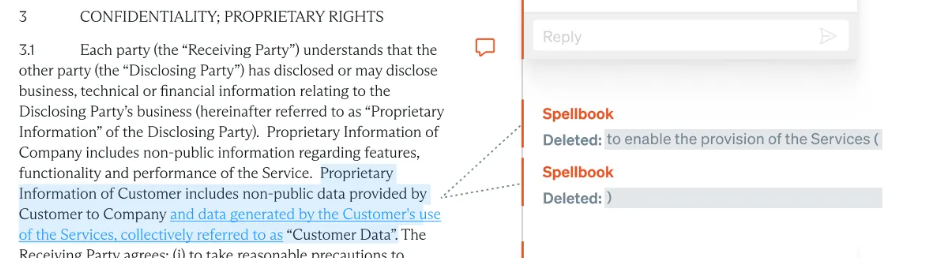
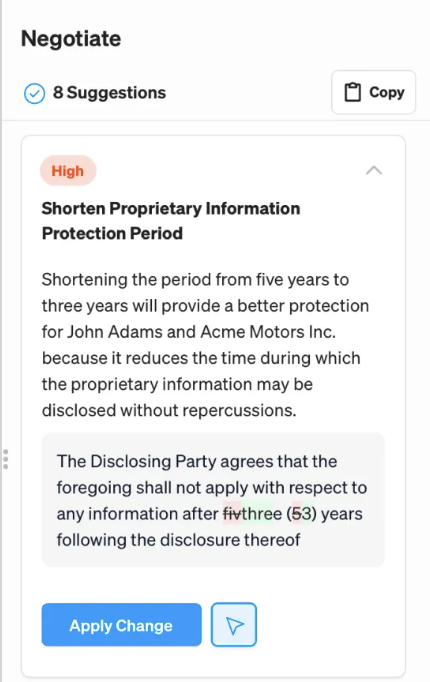
The Proofread feature in Spellbook runs the same check inside Microsoft Word without a prompt, and proposes a fix for each ambiguous phrase it flags. The lawyer decides which of those fixes to accept.
Negotiation and Strategy Prompts
Walking into a negotiation without a prioritized list means spending the first session finding out what actually matters. The four prompts below produce that preparation in order: the priorities to defend, the counterparty’s likely position, counterproposal language once the first ask is countered, and the trade that lets both sides close.
12. Identify Top Negotiation Priorities
Use this prompt when preparing for contract negotiations to focus discussions on the issues that matter most to the represented party.
SIMPLE VERSION:
“Review this contract and list the top 5 negotiation priorities for my client, ranked by importance, with a suggested trade-off for each. I represent [Party].”
ADVANCED VERSION (Structured Prompt):
“You are an experienced legal negotiator conducting strategic analysis. Your task is to identify the top 5 negotiation priorities for the represented party and suggest potential trade-offs.
PRIORITY IDENTIFICATION (Required):
- Most critical issues ranked by business impact
- Terms that create the greatest risk or constraint
- Provisions most misaligned with business objectives
- Deal-breakers vs. important but negotiable items
- Strategic value of each priority
TRADEOFF ANALYSIS:
- What you could concede to gain priority items
- Which less-important terms could be traded away
- Creative compromises that advance key objectives
- Bundling strategies for negotiation efficiency
OUTPUT FORMAT:
- List the top 5 priorities in rank order (most critical first)
- Explain why each is a priority
- Suggest specific tradeoffs for each priority
- Provide negotiation talking points for key issues
Analyze this document to identify the top 5 negotiation priorities. Your primary focus is on determining which issues matter most to the represented party and what concessions could advance those priorities.
I represent [Party].”
13. Analyze Counterparty Position
Use this prompt when preparing for or advancing negotiations to understand the counterparty’s motivations, constraints, and leverage.
SIMPLE VERSION:
“Assess the counterparty’s likely negotiating position, including their priorities, constraints, and weak points, and suggest strategies that strengthen my client’s position. I represent [Party]. The counterparty is [describe].”
ADVANCED VERSION (Structured Prompt):
“You are an experienced legal negotiator conducting a position analysis. Your task is to assess the counterparty’s negotiating position and recommend strategies to strengthen the represented party’s position.
COUNTERPARTY ANALYSIS (Required):
- Their likely priorities based on the deal structure
- Constraints they face (timeline, alternatives, internal approvals)
- Leverage points (where they need this deal)
- Weaknesses in their position (arguments that will not hold up)
- Opportunities to reframe (different ways to structure terms)
STRATEGIC RECOMMENDATIONS:
- How to use counterparty constraints
- Arguments likely to persuade them
- Concessions that cost the represented party little but benefit the counterparty
- Timing and sequencing of negotiation moves
OUTPUT FORMAT:
- Analyze the counterparty’s likely position and constraints
- Identify the represented party’s leverage points
- Recommend specific negotiation strategies
- Provide tactical guidance for key discussions
I represent [Party]. The counterparty is [describe opposing party if known]. Your primary focus is assessing the counterparty’s negotiating position and recommending strategies that strengthen the represented party’s position.”
14. Draft Counterproposal Language
Use this prompt when responding to proposed contract language that raises legal or commercial concerns but still requires a constructive path forward.
SIMPLE VERSION:
“Draft alternative language for this clause that addresses my concerns while still meeting the counterparty’s underlying interests. Current provision: [paste clause]. I represent [Party].”
ADVANCED VERSION (Structured Prompt):
“You are a senior contract attorney drafting counterproposals. Your task is to draft alternative language that addresses the represented party’s concerns while meeting the counterparty’s underlying interests.
Current provision: [paste the clause you are countering]
The represented party’s concerns are: [specify concerns, or omit to let AI infer from context]
COUNTERPROPOSAL APPROACH (Required):
- Address the represented party’s specific concerns
- Acknowledge the counterparty’s legitimate interests
- Provide a commercially reasonable middle ground
- Use clear, enforceable language
INTEREST ANALYSIS:
- What the counterparty is trying to accomplish
- How to achieve their goal with less risk to the represented party
- Win-win formulations, if possible
- Fallback positions if the primary proposal is rejected
OUTPUT FORMAT:
- Draft complete alternative language
- Explain how it addresses the represented party’s concerns
- Show how it meets the counterparty’s underlying needs
- Provide a rationale for the approach taken
Draft a counterproposal that addresses concerns while remaining commercially reasonable. Your primary focus is on creating alternative language that protects the represented party while acknowledging counterparty interests.
I represent [Party].”
15. Find Win-Wins
Use this prompt when negotiations reach a point where collaboration can create additional value for both sides.
SIMPLE VERSION:
“Suggest 3-5 changes to this agreement that benefit both sides while advancing my client’s priorities, and explain the mutual benefit for each. I represent [Party].”
ADVANCED VERSION (Structured Prompt):
“You are an experienced legal negotiator finding collaborative solutions. Your task is to identify modifications that improve the agreement for both parties while advancing the represented party’s key objectives.
For each win-win opportunity:
WIN-WIN IDENTIFICATION (Required):
- What changes in the provision
- Why it benefits both parties
- How it advances the represented party’s priorities
- Why the counterparty should accept
- Implementation requirements
MUTUAL BENEFIT ANALYSIS:
- Terms where both parties’ interests align
- Provisions that create unnecessary friction
- Opportunities to expand value for both sides
- Low-cost concessions that matter to the other side
OUTPUT FORMAT:
- Identify 3-5 win-win opportunities
- Explain mutual benefits clearly
- Show how each advances the represented party’s objectives
- Provide negotiation framing for each opportunity
I represent [Party]. Your primary focus is identifying opportunities for mutually beneficial modifications that advance the represented party’s key priorities.”
Legal Research Prompts
Lawyers turn to AI for legal research when they need a fast orientation to an issue before committing hours to full research. Prompt structure matters even more here than in drafting, because no document sits in front of the tool to constrain the answer, so a fabricated citation has nothing to contradict it.
16. Summarize Case Law for a Specific Issue
Use this prompt when a lawyer needs a quick overview of how courts have ruled on a specific legal issue before diving into full research.
SIMPLE VERSION:
“Summarize how courts in [jurisdiction] have ruled on [legal issue] over the past [time period]. Note the general trend and flag anything I should verify independently. I represent [Party].”
ADVANCED VERSION (Structured Prompt):
“You are a senior legal research attorney summarizing case law. Your task is to provide an overview of how courts have addressed a specific legal issue.
[Specify the legal issue and jurisdiction]
RESEARCH PARAMETERS (Required):
- Jurisdiction (specify courts and governing law)
- Date range (limit to the relevant time period)
- Issue framing (the precise legal question at stake)
- Procedural posture (how the issue typically arises)
- Verification flags (mark any holding, citation, or trend that must be confirmed against a primary source)
ANALYSIS APPROACH:
- Identify the prevailing rule or majority position
- Note minority or emerging approaches
- Highlight any jurisdictional splits
- Distinguish settled law from contested or evolving areas
OUTPUT FORMAT:
- Lead with the general trend in one or two sentences
- Summarize key approaches with brief explanations
- Clearly label any case name or citation as ‘requires verification’
- End with the open questions that warrant full research
Summarize the case law on this issue within the specified jurisdiction and date range. Your primary focus is on giving an accurate orientation to the issue while clearly flagging every point that requires independent verification against primary sources.
I represent [Party].”
The Ask feature in Spellbook answers legal questions from legal-specific sources, so the orientation comes back without a research prompt built by hand. Every citation it returns still requires verification against the primary source.
17. Identify Relevant Precedents
Use this prompt when a lawyer is building a legal argument and needs to quickly surface the strongest supporting precedents.
SIMPLE VERSION:
“Find the strongest precedents in [jurisdiction] supporting [the position being argued]. Rank them by relevance and tell me which are binding versus persuasive. I represent [Party].”
ADVANCED VERSION (Structured Prompt):
“You are a senior legal research attorney building an argument. Your task is to identify the strongest precedents that support the represented party’s position.
PRECEDENT SEARCH (Required):
- Legal issue or position being argued (state it precisely)
- Jurisdiction (specify governing courts and law)
- Binding vs. persuasive authority (distinguish clearly for each case)
- Strength of support (how directly each precedent applies)
- Verification flags (mark every case name and citation as requiring confirmation against a primary source)
ARGUMENT ALIGNMENT:
- How each precedent advances the represented party’s position
- Factual similarities that strengthen applicability
- Distinguishing factors a court might raise
- Counter-authority the opposing side could cite
OUTPUT FORMAT:
- Rank precedents by relevance (most directly supportive first)
- Label each as binding or persuasive in the stated jurisdiction
- Explain in one or two sentences why each supports the argument
- Flag every citation as ‘requires verification’
Identify the precedents most likely to support this position within the specified jurisdiction. Your primary focus is to surface the strongest authority, clearly distinguish between binding and persuasive sources, and flag all citations for verification.
I represent [Party].”
18. Check a Statute’s Current Applicability
Use this prompt when a lawyer needs to verify whether a statute is still in force, has been amended, or has been interpreted in a way that affects a client matter.
SIMPLE VERSION:
“Tell me whether [statute name] in [jurisdiction] is still in force and how it applies to [the legal question]. Flag anything that may have changed recently and that I need to confirm against the current code. I represent [Party].”
ADVANCED VERSION (Structured Prompt):
“You are a senior legal research attorney assessing statutory applicability. Your task is to evaluate whether a statute applies to a specific legal question and whether its current status is settled.
STATUTORY REVIEW (Required):
- Statute name and jurisdiction (identify the governing code precisely)
- Specific legal question to which the statute is being applied
- Current status (in force, amended, repealed, or superseded to the extent known)
- Relevant judicial interpretation affecting how the statute is applied
- Real-time limitation flag (explicitly note that AI cannot confirm the latest legislative or amendment status and that the current code must be checked directly)
APPLICABILITY ANALYSIS:
- How the statute applies to the stated facts or question
- Conditions or thresholds that trigger or limit application
- Interpretive gaps or ambiguities a court would resolve
- Related provisions that may also apply
OUTPUT FORMAT:
- State how the statute applies to the question
- Summarize known status and any interpretation, labeled for verification
- Lead with a clear statement that legislative status must be confirmed against the current official code
Assess how this statute applies to the stated question. Your primary focus is on explaining applicability while clearly flagging that you cannot verify real-time legislative updates. The user must confirm the statute’s current status against the official code.
I represent [Party].”
Client Communication Prompts
Drafting plain-language updates eats into billable time, especially for routine messages that still need to read well. AI prompts let lawyers produce polished, jargon-free client communication in a fraction of the time, turning a 20-minute email into a quick draft-and-refine.
19. Draft a Case Status Update Email
Use this prompt when a lawyer needs to send a client update but wants to avoid spending time on tone and structure for a routine communication.
SIMPLE VERSION:
“Draft a professional, plain-language email updating my client on their matter. Current stage: [stage]. Recent developments: [general summary]. Next step: [next step]. Keep it clear and reassuring without legal jargon.”
ADVANCED VERSION (Structured Prompt):
“You are a senior attorney drafting client correspondence. Your task is to write a clear, professional case status update email that keeps the client informed without overwhelming them.
UPDATE CONTENT (Required):
- Case stage (where the matter currently stands)
- Recent developments (what has happened since the last update)
- Next steps (what happens next and any expected timing)
- Client action items (anything the client needs to do, if applicable)
- Confidentiality note (do not include sensitive case facts, privileged details, or confidential client information in this prompt)
TONE GUIDANCE:
- Professional but warm and approachable
- Plain language, minimal legal jargon
- Reassuring without overpromising outcomes
- Concise enough to read on a phone
OUTPUT FORMAT:
- Clear subject line
- Brief opening that orients the client
- Short paragraphs or bullets for recent developments and next steps
- A closing that invites questions
Draft a client-ready status update email based on the provided stage and developments. Your primary focus is communicating progress clearly and professionally in plain language, without requesting or including any confidential case details.”
20. Explain a Legal Concept to a Non-Lawyer Client
Use this prompt when a lawyer needs to communicate a complex legal concept, such as indemnification, force majeure or material breach, to a client without a legal background.
SIMPLE VERSION:
“Explain [legal concept] to my client in plain English. They have no legal background. Keep it accurate but simple, and tie it to why it matters for their situation: [brief context].”
ADVANCED VERSION (Structured Prompt):
“You are a senior attorney explaining legal concepts to clients. Your task is to make a complex legal concept clear and useful to someone without a legal background.
EXPLANATION CONTENT (Required):
- The concept to explain (for example, indemnification, force majeure, material breach)
- Client context (why this concept matters to their specific situation)
- Reading level (target a general, non-legal audience)
- Practical impact (what it means for the client in concrete terms)
- Accuracy guardrail (simplify without distorting the legal meaning)
CLARITY APPROACH:
- Avoid legal jargon; define any unavoidable term in plain language
- Use a brief, relatable analogy where it aids understanding
- Connect the concept directly to the client’s circumstances
- Anticipate the client’s likely follow-up question
OUTPUT FORMAT:
- Open with a one-sentence plain-language definition
- Explain why it matters to the client
- Use a short example or analogy if helpful
- Keep it brief and scannable
Explain this concept clearly to a non-lawyer client in the context provided. Your primary focus is making the concept genuinely understandable while keeping the explanation legally accurate.”
21. Summarize Next Steps After a Consultation
Use this prompt when a lawyer wants to send a post-consultation follow-up that summarizes what was discussed and what the client needs to do next.
SIMPLE VERSION:
“Draft a follow-up email summarizing our consultation. Topics discussed: [keep general]. Client’s action items: [list]. My action items: [list]. Suggest a timeline for our next check-in. Keep the tone professional and clear.”
ADVANCED VERSION (Structured Prompt):
“You are a senior attorney drafting post-consultation follow-ups. Your task is to write a clear summary email that confirms what was discussed and sets out next steps for both sides.
FOLLOW-UP CONTENT (Required):
- Matters discussed (keep this general in the prompt, do not include confidential or privileged specifics)
- Client action items (what the client needs to do and by when)
- Lawyer action items (what the attorney will handle next)
- Proposed timeline (when the client can expect the next update or contact)
- Confidentiality note (summarize topics at a high level; omit sensitive facts from the prompt itself)
STRUCTURE APPROACH:
- Confirm shared understanding of what was covered
- Separate client responsibilities from lawyer responsibilities clearly
- Make action items specific and assignable
- Set expectations for timing and next contact
OUTPUT FORMAT:
- Clear subject line referencing the consultation
- Brief recap of topics at a general level
- Two labeled lists: ‘Your next steps’ and ‘What we will handle’
- Closing with the proposed timeline and an invitation to ask questions
Draft a professional post-consultation summary email based on the general topics and action items provided. Your primary focus is confirming next steps clearly for both parties without including any confidential consultation details in the output.”
Defined Terms and Consistency Prompts
A long agreement accumulates defined terms that are never used, used terms that were never defined, and the same term defined twice in different words. These two prompts audit the definitions as a set, and then test one term against every place it appears, including the schedules.
22. Audit the Defined Terms in an Agreement
Use this prompt when reviewing a long agreement to check whether its definitions are complete, used and internally consistent.
SIMPLE VERSION:
“Audit the defined terms in this agreement. List every term that is defined but never used, every capitalized term that is used but never defined, and every term that is defined more than once. I represent [Party].”
ADVANCED VERSION (Structured Prompt):
“You are a senior contract attorney auditing the definitions in an agreement. Your task is to assess whether the defined terms are complete, consistent and actually used.
DEFINITION AUDIT (Required):
- Terms defined in the definitions section but never used in the operative provisions
- Capitalized terms used in the operative provisions or schedules with no definition anywhere
- Terms defined more than once, including definitions embedded in the body
- Definitions that incorporate another defined term that is itself undefined
- Definitions that conflict with how the term is used
IMPACT ANALYSIS:
- Which undefined terms carry operative obligations
- Where a conflicting definition changes the scope of a right or a duty
- Which gaps would be read against the represented party
OUTPUT FORMAT:
- Group findings as unused, undefined, duplicated and conflicting
- Quote the sentence and give the section number for each finding
- Rank the findings by the exposure they create for the represented party
- Propose a correction for each one
Audit the definitions in this agreement. Your primary focus is identifying definitional gaps and conflicts that change how an operative provision would be read.
I represent [Party].”
23. Check One Defined Term for Consistency
Use this prompt when a single defined term carries commercial weight and has to mean the same thing everywhere it appears.
SIMPLE VERSION:
“Find every use of the defined term [Term] in this agreement, including the schedules and exhibits. Flag any use that is inconsistent with the definition, uses the term without capitalization, or substitutes a synonym. I represent [Party].”
ADVANCED VERSION (Structured Prompt):
“You are a senior contract attorney testing one defined term for consistency across an agreement.
The term is: [Term]
CONSISTENCY REVIEW (Required):
- Every location the term appears, including schedules, exhibits and annexes
- Uses that fall outside the stated definition
- Uses of the term in lower case where the defined meaning is intended
- Synonyms or near-synonyms used in place of the defined term
- Cross-references to the definition that point to the wrong section
INTERPRETATION IMPACT:
- Where an inconsistent use narrows or widens an obligation
- Where a synonym creates an argument that a different meaning was intended
- Which inconsistencies a counterparty could rely on
OUTPUT FORMAT:
- List every occurrence with its section number
- Mark each as consistent, inconsistent or ambiguous
- Quote the sentence for every occurrence that is not consistent
- Recommend the specific wording change for each one
Test this term for consistency throughout the agreement and its schedules. Your primary focus is identifying uses that depart from the definition in a way that changes the meaning of an obligation.
I represent [Party].”
[cta-2]
How to Fix an AI Prompt That Returns the Wrong Answer
A legal AI prompt that returns the wrong answer is usually fixed by narrowing it, not by rewriting it from scratch. Work through four follow-up prompts in order. First, narrow the scope: name the clause, section or schedule the answer should come from, so the tool stops drawing on the rest of the document. Second, name the standard: state the position the answer should be measured against, such as the party you represent or the fallback your team has accepted before. Third, ask for the source: require the tool to quote the sentence in the document each finding rests on, which exposes a finding that is not in the text. Fourth, ask for what is missing: a tool that has answered the question asked will often not volunteer the term the document never addressed.
Narrow the Scope
“Limit your answer to [clause, section or schedule] in this agreement and ignore the rest of the document. If that provision does not address the question, say so rather than answering from elsewhere in the agreement.”
Name the Standard
“Answer again, measured against this standard: [the position I represent, or the fallback my team has accepted before]. For each finding, state whether the provision meets that standard, falls short of it, or is silent.”
Ask for the Source
“For each finding in your previous answer, quote the sentence in the document it rests on and give the section number. If you cannot quote a sentence, mark that finding as unsupported.”
Ask for What Is Missing
“You answered the question I asked. Now tell me what this agreement does not address that a [contract type] of this kind normally would, ranked by the exposure each gap creates for [Party].”
Prompt Engineering Best Practices
Prompt engineering matters for lawyers because the quality of an AI output depends heavily on how the task is framed. The practices below are the ones that change the output most.
- Use a structured prompt framework: a structured prompt constrains what the model returns and in what order, not how it reasons. Clear sections reduce missed issues and improve consistency.
- Break complex tasks into steps: a single prompt asking for review, risk ranking and redraft in one pass tends to shortchange the last ask. Splitting the task into stages catches more at each stage and produces a tighter answer.
- Use iterative prompting to refine results: treat the first output as a working draft, and follow up with a narrower or more specific version of the same prompt until the answer holds up under question, the way the follow-up prompts above do.
- Compare perspectives to stress-test clauses: running the same clause past the prompt once from each side’s position surfaces a weakness that a single-sided review would not have flagged.
- Control tone and legal style: an instruction that fixes the register, such as a formal memo rather than a client-ready email, changes the draft from something that needs a rewrite to something that goes out as is.
- Modify and reuse proven prompts: an effective prompt becomes a reusable asset.
The sixth practice is the one that compounds. The discipline of turning a working prompt into a reusable one is what keeps the output consistent once more than one lawyer on the team runs the same task.
Risks and Limitations When Using AI Prompts for Lawyers
The risks and limitations of AI prompts for lawyers cluster in four places: fabricated authority, confidentiality, jurisdiction-specific law, and the professional duty that no prompt transfers. A better prompt narrows the first three and does nothing to the fourth. The Thomson Reuters Institute 2026 AI in Professional Services Report reports that 40% of professionals say their organization now uses generative AI, up from 22% a year earlier. Adoption on that scale does not settle the question of how far the output can be relied on, and the profession’s own answer to that question has remained cautious even as everyday usage has climbed. The same report cites a 2024 Thomson Reuters Institute survey in which only 17% of legal professionals felt comfortable with AI giving legal advice. Each limitation below names what goes wrong and what the prompt should say to contain it.
Fabricated Authority
AI systems generate confident, incorrect statements in legal research especially, including cases, statutes and contractual norms that do not exist, and the same prompt can return different findings on two runs. A fabricated citation reads exactly like a real one. What the prompt should say: require the tool to label every case name and citation as requiring verification, and to quote the sentence each finding rests on.
Confidentiality
Putting client information into a tool whose data-handling practices are unclear creates a confidentiality exposure, and a prompt that carries pasted document text is the most common way it happens. What the prompt should say: describe the matter in general terms, and leave names, deal values and identifiers out of the prompt text.
Jurisdiction-Specific Law
AI output can read correctly in general terms and still miss the governing rule, local market practice or a recent amendment. What the prompt should say: state the governing law, and require the answer to flag where the rule differs by jurisdiction and where the position may have changed.
The Professional Duty No Prompt Transfers
AI cannot form an attorney-client relationship or give legal advice, and highly fact-specific or novel questions exceed what it can analyze. Responsibility for interpretation, advice and outcome rests with the lawyer, so routine reliance on AI output without reading the underlying provision is the risk that no prompt reduces. What the prompt should say: nothing. This is the one limitation a better prompt does not narrow.
[cta-3]
What to Check Before You Trust an AI-Generated Contract Summary
A legal team should check five things before trusting an AI-generated contract summary: that every defined term in the output is defined in the agreement, that each cross-reference points to a section that exists, that figures tie to the schedule and not the body, that every clause described can be located in the text, and that party names, dates and governing law match the execution version. A fabricated clause reads exactly like a real one, so none of these failures is visible in the output alone.
- Defined terms. Take each capitalized term in the summary back to the definitions section. A summary that describes a “Permitted Transfer” where the agreement defines only “Transfer” has imported a concept the parties did not agree.
- Cross-references. Open every section number the summary cites. The common failure is a reference to a section that exists but says something else, which survives a skim because the number is real.
- Figures. Check caps, thresholds and payment amounts against the schedule rather than the body. Where the body and a schedule disagree, a summary tends to report whichever appeared first.
- Clause existence. For each clause the summary describes, find the sentence that creates it. A summary built from a typical agreement of that type will describe the clause the document should have contained rather than the one it does.
- Execution-version details. Confirm party names, dates, the governing law clause and the signature blocks against the version that was actually signed. Summaries are often produced from an earlier draft still sitting in the folder.
Running those five checks is the verification step behind the professional obligations a lawyer carries when using a general-purpose AI tool, and no prompt moves that obligation onto the tool.
Running These Prompts in an AI Tool Built for Lawyers
An AI prompt tool built for lawyers runs prompts like these against the document already open, which removes most of the context a general-purpose tool has to be told. Spellbook, the AI suite for transactional legal work, is built this way: the Review feature surfaces risks and proposes redlines as native Word tracked changes, the Draft feature completes clause language inside the agreement using the Clause Library for the language itself, and the Compare to Market feature measures a term against 20M+ real contracts rather than a model’s general sense of what is standard. A lawyer still reviews every redline, draft and comparison before it leaves the document.
The prompting difference is that the role, the document and the market reference are already held by the tool, so a shorter instruction returns work closer to what a lawyer would accept.
Transactional teams working from these categories can also run the 35+ prompts written for transactional legal work, which cover the same drafting and review tasks at clause level.
Final Thoughts
AI prompts for lawyers are one of the most practical ways to get value from AI without rebuilding a workflow. A well-structured prompt does more than save time on drafting and review: it surfaces risk earlier, sharpens negotiation priorities, and brings consistency to work that is usually done against a deadline.
.png)
The prompts above are built to accelerate the work. Final judgment, legal accuracy and client accountability rest with the lawyer. Review every output, verify every citation against its primary source, and apply professional judgment before anything reaches a client or a counterparty.
Read the State of Contracts report to see how commercial teams are standardizing the terms these prompts touch.
Frequently Asked Questions
What Are Some Effective AI Prompts for Lawyers?
The effective ones name a role, the background facts, one task, an output format and the constraints. In practice that reads as: “You are a senior contract attorney reviewing a supply agreement for [Party]. Flag every clause where obligations or risk fall disproportionately on [Party], ranked by exposure, and quote the sentence each finding rests on.” A prompt that names only the task returns a general answer.
Which Legal Tasks Do AI Prompts Handle Best?
Tasks where the source document sits in front of the tool: drafting defined terms and clause language, reviewing for imbalance or missing provisions, summarizing a long agreement, and checking a defined term for consistency. Tasks that require authority the tool has to retrieve, such as case law and statutory status, carry the highest verification burden.
Does Giving an AI Tool Examples in a Prompt Train It to Handle Legal Work?
No single prompt trains the underlying model. What a detailed prompt does is narrow one answer: using precise language that defines the legal terms and context, and providing examples such as past precedents or contract templates, gives that response more to work from. A tool already trained on legal documents needs less of this scaffolding in the prompt itself, because the training lives in the tool rather than in each prompt.
- Monthly AI spend
- ROI of legal tools
- Impact of AI



.png)
.jpg)
.png)
.svg)



Submission Received
Thank you for your interest!
.svg)
